

Small Payment Institution
We are leaders in legal support for small payment institutions. We helped dozens of companies obtain an SPI license and safely run payment business.

marki fintech, z którymi pracowaliśmy


















how can we help you?
MIP foundation
We have helped dozens of companies become MIP. We will be happy to help you too. We will efficiently prepare everything necessary to submit an application to the Polish Financial Supervision Authority and handle the entire licensing procedure so that your company can develop its payment business.
Find out moreBusiness advisory
Use the full potential of your MIP license. We will support you in developing appropriate products and solutions, as well as finding business partners. With us you will maximize the profits of your payment institution.
Find out moreDORA
Implementing the DORA regulation in small businesses is a challenge. However, we have proven ways to effectively ensure digital resilience and legal compliance in your small payment institution. We know how to do it effectively.
Find out moreAML
We have extensive experience in implementing anti-money laundering procedures in small payment institutions. We will develop appropriate solutions for you and provide the necessary training.
Find out moreOngoing legal support
Contracts? Regulations? Replies to letters from the Polish Financial Supervision Authority or the GIFI? Nobody likes it. In addition, the regulations change every day. At Legal Geek, we provide payment institutions with ongoing legal support. Thanks to us, you can focus on making money, not on regulations.
Find out moreMIP Sale/Purchase
Do you have a MIP and want to sell it? Or maybe you are looking for a ready-made small payment institution? We will not only help you find the right buyer or seller, but we can also conduct appropriate due diligence.
Find out moreAudits / Compliance DD
Maintaining compliance with dynamically changing regulations is quite a challenge. Therefore, we will examine whether your payment institution meets current regulatory requirements and help you adapt to them. We will also conduct an annual evaluation of procedures.
Find out moreCompliance / Audits
We know how much internal legal and compliance departments have on their minds. That's why we help them face challenges on an ongoing basis. Whether in the field of AML or DORA, as well as in other areas of broadly understood compliance - we will provide you with support!
Find out moreTraining
Among the numerous duties there are also training ones. We can conduct both dedicated stationary training for you and provide you with an e-learning platform, which is a cheap and effective way of providing annual AML or DORA training.
Find out morewhy choose legal geek?
About SPI
Small Payment Institutions (MIP) have been operating in Poland since 2018. Since then, over 250 of them have been created. MIP may operate on a similar principle to the National Payments Authority (KIP), but the requirements for MIP are less stringent, thanks to which more entities can obtain the necessary authorizations.
The MIP license is realistically the minimum license required to offer innovative payment services. Thanks to it, you can, among others: issue payment cards, provide BLIK payments to others or run virtual purses.
The costs of establishing and running MIP are incomparably lower than in the case of National Payment Institutions.
Who is MIP for?
Payment Gateways
If you want to enable accepting payments with payment instruments, e.g. BLIK or card.
Marketplace
If you connect two websites and want to process payments, e.g. for the sale of goods, provision of services or donations (donations / tips).
Loan services
With an MIP license you have additional opportunities to increase revenues in your lending company (including BNPL).
Small Payment Institution
Currency exchange platform
It runs the so-called virtual purses (possibility to store funds for future transactions).
Automatic payments
Application for automatic bill payments (gas, electricity, internet, cable) - transfer service, including from a payment card.
Loan company
Issuing its own credit cards - i.e. issuing payment instruments.
Charity collections
A platform for collecting money for charity and handling payments for it.
Cryptocurrency exchange office
Exchanging cryptocurrencies for "classic" currencies (FIAT) as part of payment services.
Recurring payments
A company that handles recurring payments for memberships, e.g. for gyms and swimming pools.
Parking
An application or system for paying for parking spaces in large cities.
Deferred payments
BNPL service (Buy Now, Pay Later), enabling deferred payment for purchases in online stores.
what are the limits of MIP?
A small payment institution has enormous possibilities and in practice only three limitations
Funds limit for the user
The maximum amount of funds stored at a given time for one user cannot be higher than EUR 2,000 - this is the amount of funds stored in the account, not the amount of transfers (these may be higher!).
RPM limit
The average monthly turnover in 12 months cannot exceed EUR 1,500,000 - that is, EUR 18 million per year. If you exceed this limit, you must apply for a license from a national payment institution.
Territorial limit
You can only conduct business in Poland. You cannot have agents or branches abroad.
Small Payment Institution
As a rule, any entity that comes into possession of money in order to transfer it to another person must become an MIP.
This means that if, for example, you provide a payment gateway, your company should be MIP. If you run a marketplace and funds from buyers go into your account and you later pay them to the seller - you generally have to be an MIP.
Not sure if you need MIP status?
Contact us and we will help you determine whether your business requires obtaining the status of a Small Payment Institution.
Small Payment Institution
Meet specialists who have been successfully helping to obtain the status of a Small Payment Institution and providing support to entities from the fintech industry for years.

Tomasz Klecor
Managing Partner
FinTech navigator. Lawyer.

Paweł Geremek
Attorney-at-law
ISO 27001 Auditor
SPI questions and answers
Below you will find answers to the most frequently asked questions about the Small Payment Institution.
Any entity that has its registered office or residential address in Poland and meets the conditions provided for in the Payment Services Act may become a small payment institution.
NO. MIP does not require any specific form of running a business. Also, both a natural person acting alone and, for example, a general partnership, limited partnership or limited liability company may become an MIP. or joint stock.
Unlike national payment institutions, small payment institutions do not have any requirements regarding share capital. Therefore, MIP must only have the share capital required for a given legal form (for a limited liability company it is PLN 5,000).
NO. MIP does not have to have its own funds or meet any other specific capital requirements.
Yes. Even a newly established special purpose vehicle with the minimum required share capital may become an MIP. There are also no restrictions for companies established under the S24 procedure.
This time depends on many factors, but on average it is about 3 months. The time needed to prepare documents by Legal Geek is usually 2-4 weeks. The duration of proceedings before the Polish Financial Supervision Authority varies. By law it is up to 3 months, but usually the Polish Financial Supervision Authority registers MIPs in about 2 months. Our record is 11 days.
We have indicated the documents that MIP must have in the DOCUMENTS section. At the very bottom of the page. Some of these documents are submitted with the application for entry, and some are delivered to the Polish Financial Supervision Authority later.
It depends ð
Much depends on the structure and development of the institution itself. In the case of "small" payment institutions (e.g. a few employees, simple structure, simple transaction scheme) - these expenses are usually small and do not constitute an additional burden.
In the case of larger entities (especially joint-stock companies) there is a bit more of it. Nevertheless, with appropriate process automation, it can be updated accordingly.
For most of our clients, the real workload due to the MIP status does not exceed 1/8 of the full-time position.
In principle, yes. MIP should have a separate bank account to protect funds from users. It should be kept in a domestic bank (PL IBAN).
In some cases, this bill can be replaced by a guarantee or policy. However, the bill is the recommended solution.
Of all the MIP's responsibilities, in our opinion the most important are:
- application of AML/CFT regulations;
- protection of user funds;
- compliance with statutory limits;
- conducting business activities only in Poland;
- meeting reporting obligations.
How to become an SPI?
We provide our clients with comprehensive services in the preparation of documentation and procedures necessary for a small payment institution and submitting an application to the Polish Financial Supervision Authority. We ensure that proceedings are conducted on behalf of the client, as well as the so-called "post-implementation support", i.e. a whole range of activities after obtaining the MIP license (including assistance with the first reports).
We strive to ensure that activities related to obtaining an MIP license do not burden our clients and we arrange the process so that over 90% of the work is handled by the Legal Geek team. Additionally, we provide extensive additional support to payment institutions, lending institutions and the entire FinTech sector, including the subsequent transformation of MIP into a national payment institution.
Complete documentation
We prepare full documentation required to submit an application for entry into the MIP register and procedures necessary to run a business.
Representation before the Polish Financial Supervision Authority
We conduct proceedings before the Polish Financial Supervision Authority, answer questions and ensure efficient communication.
Training and audits
We provide MIP and AML training and workshops for your team to prepare them for new responsibilities.
Post-implementation support
We assist in the first reports to the Polish Financial Supervision Authority, the National Bank of Poland and the Financial Ombudsman, and we also support in response to the sectoral letter.
What does cooperation with us look like:
We approach each "MIP project" holistically. We want your company not only to become a small payment institution, but also to be fully compliant with the law. Therefore, customers who If you want to become an MIP, we provide comprehensive services, and our cooperation does not end with obtaining a license. We help you long after you become a small payment institution, including with your first duties reporting. With us you will become MIP in 13 steps!
Conversation
A no-obligation telephone conversation during which we will determine whether you actually need MIP, as well as what your needs are related to this license. Based on it, we will determine the scope of our work. The call is completely free and usually lasts about 15-45 minutes.
Offer
We will present you an offer detailing the individual elements of our activities - necessary for you to obtain a license as a small payment institution. Additionally, we will offer additional services that are not necessary in the licensing proceedings, but affect the proper functioning of MIP (e.g. GDPR documentation).
Signing the contract
If you accept our conditions, we will sign a contract. Don't worry - our contract is short and simple! ð Additionally, we will ask you to pay the first of two parts of our remuneration - this is necessary to start the work.
Question list
On your side there is business, on ours - documents. Therefore, to start with, we will provide you with a list of the most important information that we will need. We will also ask you to prepare a financial program (according to our guidelines) and to open a bank account for MIP purposes.
Startup meeting
During the conversation, we will discuss the questions we have given you and collect the information we need. The conversation can take place remotely (e.g. Google Meet, MS Teams) or at our place in Sopot. We will clarify the scope of the application and determine the exact nature of the provision of payment services by your company.
Work on documentation
Over the next 2-4 weeks we will prepare the documents necessary to submit the application. This time depends, among others, on: depending on how quickly we receive answers to previously sent questions. Of course, our team is at your disposal all this time.
Training
While we are working on the documents, you will receive access to the e-learning platform with training on small payment institutions and anti-money laundering (AML). After completing the training, you will receive the appropriate certificate.
Submitting an application to the Polish Financial Supervision Authority
Once the documents are ready and we discuss them together and determine that everything is correct, we will ask you for the second part of our remuneration. Then, on your behalf, we will submit an application to the Polish Financial Supervision Authority for entry into the register of small payment institutions.
Proceedings before the Polish Financial Supervision Authority
Proceedings before the Polish Financial Supervision Authority usually last about 2-3 months. Of course, sometimes the Polish Financial Supervision Authority will surprise us and end it in... a week (we have such a record). During this time, on your behalf, we conduct any correspondence with the supervisor and answer any questions that may arise.
ENTRY IN THE MIP REGISTER!
Success! Your company has become MIP! You can start providing payment services now!
Sectoral letter from the Polish Financial Supervision Authority
Entry in the register is only the beginning of your adventure as a small payment institution. However, we are with you and support you. We will prepare a response to the so-called "sectoral letter", which newly registered MIPs usually receive right after the entry.
MIP/AML workshops
Once your company is ready to start operating as a small payment institution, we will conduct approximately two-hour online workshops for your team. To prepare you even better for your new role.
Support in incidents and breaches
New responsibilities can be stressful. Therefore, in the first year of your activity as MIP, we will support you in submitting each first report of a given type. Both to the Polish Financial Supervision Authority, the National Bank of Poland and the Financial Ombudsman.
Documentation and procedures
Small Payment Institution
Download the complete guide that will help you understand all aspects of setting up and running a Small Payment Institution. The document contains practical advice, legal requirements and tips from experts.
Download the guide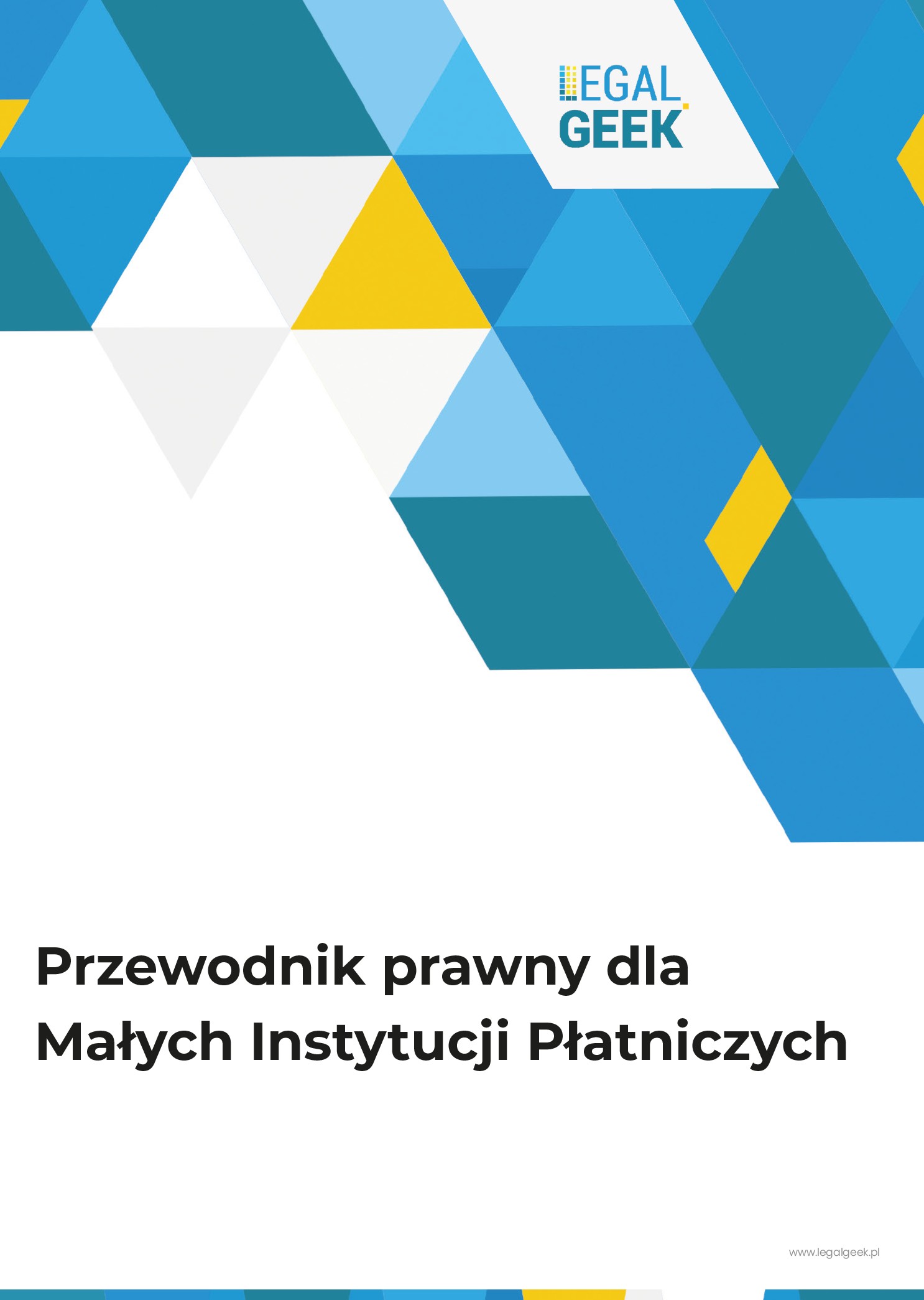
Necessary documents for each MIP:
The following documents and procedures are always created for each Small Payment Institution.
One of the basic MIP documents. Prepared for 12 months. It is true that the regulations do not specify the detailed content, but from the practice of the Polish Financial Supervision Authority, it refers here to the regulations regarding national payment institutions.
We create this document together with you, based on the questions we send you at the start.
The financial plan mainly includes the balance sheet and profit and loss account forecast for 12 months. For this purpose, it is necessary to prepare an index assessment.
We help our clients do it as best as possible.
Another key document for MIP that we develop based on the information collected from you. The procedure specifies, among others: ways of identifying, measuring and controlling various types of risks in MIP activities.
The procedure for counteracting money laundering and terrorism financing is one of the most important documents in the MIP. It defines the rules for identifying and verifying customers, monitoring transactions and reporting suspicious activities.
Additionally, the following may be required:
The documents below are not necessary to obtain registration, but in many cases they will be NECESSARY to start a business. A Small Payment Institution, for example, must meet the requirements regarding information contained in contracts with users. We can prepare these documents for you for additional orders.
Documentation related to the use of ICT services - basically necessary for every small payment institution to start its business. Implementation of the DORA regulation.
A set of procedures for entrusting operational activities to external entities, taking into account supervisory requirements. In the case of DORA documentation, we also create these procedures
A set of documents related to the protection of personal data, including data protection policy, register of processing activities, procedures for exercising the rights of data subjects.
AML
Anti-money laundering - AML / CFT
Small payment institutions are obliged to implement strict procedures for counteracting money laundering and terrorism financing (AML/CFT). Failure to comply with these requirements may lead to severe financial penalties and loss of reputation.
We offer comprehensive support in the area of AML:
Risk-adapted AML procedures
Development of AML procedures tailored to the risk profile of your institution, which will effectively protect your company against the risk of money laundering.
Effective KYC systems
Implementation of effective customer identification and verification (KYC) systems that will comply with legal requirements, but at the same time will not hinder the user experience.
Transaction monitoring
Creating effective transaction monitoring procedures that will allow for the detection of suspicious operations and appropriate response in accordance with legal requirements.
Risk assessment
Designing customer and transaction risk assessment systems that will allow for effective AML risk management in a payment institution.
Reporting to the GIFI
Preparation of reporting procedures to the General Inspector of Financial Information so that your company can fulfill information obligations in accordance with the Act.
Training
Training for employees in the field of anti-money laundering, adapted to the specific nature of work in a small payment institution.
Documentation and procedures
Regular updates of procedures in response to changes in regulations and new trends in the area of anti-money laundering.
Support in incidents and breaches
Support in the event of inspections by supervisory authorities - assistance in preparing documentation and representing the interests of your institution.
Daily support for your internal teams
We understand the challenges faced by internal legal and compliance departments in payment institutions. The multitude of responsibilities, constant regulatory changes and time pressure make additional expert support invaluable.
We offer:
Ongoing consultations
Ongoing consultations for compliance and AML officers, available in an ongoing or ad hoc model, depending on your needs.
Difficult cases of AML
Assistance in resolving complex anti-money laundering cases and analyzing suspicious transactions.
Reports to supervisory authorities
Support in the preparation and verification of reports to supervisory authorities, including the GIFI, the Polish Financial Supervision Authority and the National Bank of Poland.
Implementation of new requirements
Advising on the implementation of new regulatory requirements, including the DORA regulation and updates to the AML Act.
KYC/AML verification
Verification of decisions made as part of AML/KYC processes, especially if the client is classified as high-risk.
Risk assessment methodology
Support in creating and updating risk assessment methodologies, both for clients and the institution as a whole.
Process optimization
Assistance in designing and optimizing internal compliance processes, increasing work efficiency while maintaining compliance with regulations.
Technological tools
Consulting on the use of technological tools supporting compliance, including systems for monitoring transactions and automating KYC processes.
Our support for compliance and AML officers allows you to reduce the burden on your company's internal resources, while providing access to specialized knowledge and experience. Thanks to this, your team can focus on the strategic aspects of their work, being sure that current compliance challenges are professionally managed.
Business advisory
Use the full potential of your MIP license
Having the status of a Small Payment Institution is only the beginning of the journey. The key to success is to properly use the possibilities offered by this license.
Business advisory
Payment service design
We help you design and implement innovative payment services that will distinguish your company on the market. We analyze the needs of your customers and propose solutions that meet these needs while maximizing your profits.
Creating hybrid services
We combine payment services with other financial products to create end-to-end solutions that increase value for your customers and generate additional revenue streams for your business.
Establishing strategic cooperation
We help you find and establish cooperation with appropriate business partners - banks, payment institutions, technology providers who will help you expand the range of your services and increase their competitiveness.
Optimization of payment processes
We analyze and optimize your payment processes to make them more effective, secure and user-friendly. We implement the best practices from the market, tailored to the specificity of your business.
Development planning
We support you in planning a long-term development strategy, including preparation for obtaining a license from the National Payment Institution (KIP), which will allow you to operate on a larger scale, without transaction limits.
With our support, your Small Payment Institution will be able to fully use its potential and compete effectively on the dynamic payment services market.
DORA
Effective implementation of digital resilience
The DORA (Digital Operational Resilience Act) regulation introduces new, demanding standards in the field of digital security for financial institutions, including small payment institutions. For smaller entities, this is a particular challenge due to limited resources.
Our approach to implementing DORA in small payment institutions:
- We conduct a comprehensive assessment of the current state of digital resilience of your organization
- We identify gaps and areas that require adaptation to DORA requirements
- We develop a practical implementation strategy tailored to the scale of your business
- We design and implement cost-effective solutions that increase digital resilience
- We prepare the necessary documentation and procedures
- We train your team in new requirements and procedures
- We provide support in operational resilience testing
Thanks to our pragmatic approach, you will meet DORA requirements without unnecessary organizational and financial burdens. We will ensure your business remains digitally secure and compliant, while maintaining operational flexibility.
ongoing legal support
Focus on business, we will take care of the law
Dynamically changing regulations regarding the financial sector constitute a challenge for every payment institution. Tracking regulatory changes and adapting activities to them requires specialized knowledge and significant time investment.
Our ongoing legal support for small payment institutions includes:
Monitoring legal changes
Monitoring changes in national and European law relating to payment institutions, with monthly briefings on significant changes.
Terms and Conditions
Preparing and updating contracts with customers, suppliers and business partners, as well as developing and updating payment service regulations.
Messages and information
Preparing information and messages required by regulations, including information for users of payment services.
Representation before supervisory authorities
Representation before supervisory authorities, including preparing responses to letters from the Polish Financial Supervision Authority and the GIFI and support during inspections.
GDPR and data protection
Advice on personal data protection and GDPR compliance, including verification and updating of documentation and support in the event of incidents.
Subscription packages
Legal consultations available in a subscription model, tailored to your needs, ensuring cost predictability and constant access to support.
Thanks to our support, you will be able to focus on business development, knowing that all legal aspects of your business are professionally managed. We provide not only regulatory compliance, but also practical solutions that support your business goals.
MIP sale/purchase
Professional support in purchase and sale transactions of small payment institutions
For MIP sellers:
When planning to sell your Small Payment Institution, you want to get the best possible price for your business. Our support includes:
- Professional assessment of the value of your MIP
- Identifying the strengths and unique features that add value to your institution
- Preparing MIP for sales by optimizing processes and documentation
- Assistance in finding suitable buyers
- Discreet execution of the entire sales process
- Negotiating transaction terms on your behalf
- Safely carry out property transfers and notify supervisory authorities
We help you prepare your MIP to achieve the maximum sales price, while minimizing legal risk and ensuring a smooth transaction.
For MIP buyers:
Purchasing an existing Small Payment Institution may be a faster way to enter the payment services market than obtaining your own license. We offer:
- Searching for MIPs that fit your business needs
- Comprehensive due diligence, covering legal, financial and operational aspects
- Assess the risk associated with acquiring a specific institution
- Identification of potential regulatory issues
- Support in negotiating purchase terms
- Assistance in the preparation and verification of transaction documents
- Support in adapting the acquired MIP to your business assumptions after purchase
- Conducting the process of reporting changes to the Polish Financial Supervision Authority
Thanks to our experience, you can safely acquire MIP and quickly adapt it to your business needs, minimizing risk and maximizing development potential.
Compliance / Audits
Comprehensive regulatory compliance verification
Maintaining compliance with dynamically changing regulations is a significant challenge for every payment institution. Regular audits and compliance assessments are essential to avoid potential sanctions and ensure operational security.
Our audit and compliance due diligence services include:
Compatibility review
A comprehensive review of your institution's compliance with current regulatory requirements in the financial sector.
Identification of gaps
Identification of potential gaps and areas requiring improvement regarding AML, DORA, GDPR and other legal requirements.
Efficiency evaluation
Assessment of the effectiveness of existing internal procedures and their actual application in business practice.
Implementation verification
Verification of the correct implementation of obligations arising from laws and regulations regarding payment institutions.
Reporting and recommendations for management
A detailed report with recommendations for corrective actions, along with a practical plan for implementing changes.
Implementation support
Support in implementing recommended changes and improvements to processes, procedures and documentation.
Annual evaluation
Annual assessment of procedures required by law, including assessment of the effectiveness of AML procedures and money laundering risk.
Preparation for inspection
Preparation for inspections by supervisory authorities, including inspection simulation and verification audit.
Thanks to our audits, you will be sure that your payment institution operates in accordance with current legal requirements. Our recommendations will allow you not only to adapt to applicable regulations, but also to optimize internal processes, increasing their efficiency while maintaining regulatory compliance.
Training
Effective fulfillment of training obligations
Regular employee training in AML, DORA and other compliance areas is not only a legal requirement, but also a key element of building an organizational culture focused on compliance and security.
Our comprehensive training solutions:
Training and audits
- Dedicated workshops tailored to the specificity of your company, conducted by expert practitioners
- Possibility to adapt the program to different groups of employees and knowledge levels
- Considering your organization's specific challenges and processes
- Training materials for later use
E-learning platform
- Comprehensive online courses available 24/7
- Modular structure enabling flexible training planning
- Automatic progress tracking and certificate generation
- Regular content updates in line with changing regulations
- Interactive tests checking your understanding of the material
- Possibility to monitor the implementation of training obligations by employees
- Significant savings in time and costs compared to traditional training
Our e-learning platform is a particularly effective solution for ensuring compliance with annual training requirements for all employees. Thanks to it, you can easily document the fulfillment of training obligations, while providing employees with access to current and practical knowledge in a convenient form.